Subhas Chandra Bose Jayanti 2026: Remembering Netaji’s Unyielding Spirit and Vision for a Free India
153 Visited Religious News • Updated: Thursday, 15 January 2026
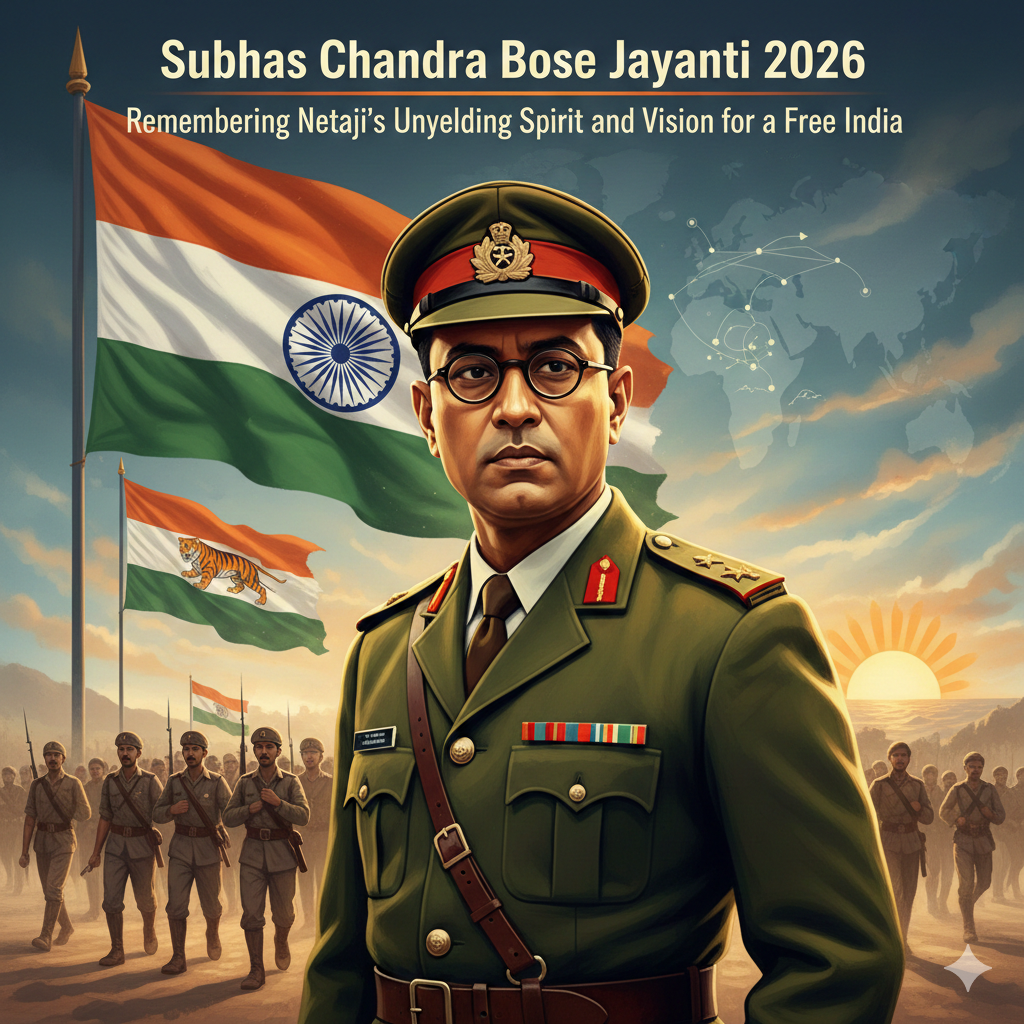
Subhas Chandra Bose Jayanti 2026: Remembering Netaji’s Unyielding Spirit and Vision for a Free India
“Give me blood, and I shall give you freedom.”
— Netaji Subhas Chandra Bose
Introduction: A Day to Honour an Immortal Revolutionary
Every year on 23rd January, India and Indians across the world commemorate Subhas Chandra Bose Jayanti, paying tribute to one of the most fearless, visionary, and revolutionary leaders of the Indian freedom struggle. In 2026, as the nation once again bows in reverence to Netaji Subhas Chandra Bose, his life, ideology, and sacrifices continue to ignite patriotism and inspire generations.
Subhas Chandra Bose was not merely a freedom fighter; he was a symbol of unyielding courage, disciplined nationalism, and revolutionary action. His belief that freedom could not be begged for but had to be seized through strength and sacrifice set him apart from many of his contemporaries. Even decades after his mysterious disappearance in 1945, Netaji remains alive in the collective conscience of the nation.
Early Life and Education: The Making of a Patriot
Subhas Chandra Bose was born on 23 January 1897 in Cuttack, Orissa (now Odisha), into a well-to-do Bengali family. His father, Janakinath Bose, was a respected lawyer and a man of strong principles, while his mother, Prabhavati Devi, instilled in him deep spiritual and moral values.
From a very young age, Subhas displayed exceptional intelligence, discipline, and a keen sense of justice. He was deeply influenced by the teachings of Swami Vivekananda, whose philosophy of strength, fearlessness, and service to the nation left a lasting impression on his mind.
He completed his early education in Cuttack and later studied at Presidency College, Calcutta, where he first came into direct conflict with British authority after protesting against racial discrimination by a British professor. This incident marked the beginning of his open resistance to colonial oppression.
ICS and the Ultimate Sacrifice: Choosing the Nation Over Prestige
Subhas Chandra Bose went to England to prepare for the Indian Civil Services (ICS) examination, one of the most prestigious careers under British rule. In 1920, he passed the examination with high merit, a remarkable achievement by any standard.
However, Bose soon realized that serving the British administration was incompatible with his conscience. In an unprecedented act of sacrifice, he resigned from the ICS in 1921, stating that he could not serve a government that enslaved his own people. This decision shocked the British authorities and inspired countless young Indians to put the nation above personal ambition.
Role in the Indian National Congress
After returning to India, Subhas Chandra Bose joined the Indian National Congress (INC) and quickly rose through its ranks due to his organizational skills and fearless approach. He worked closely with leaders like Chittaranjan Das, whom he regarded as his political mentor.
Bose served as the President of the Indian National Congress in 1938 (Haripura Session) and again in 1939. As Congress President, he emphasized industrial development, national planning, and strong resistance to British rule.
However, ideological differences—especially regarding the approach to achieving independence—led to conflicts with Mahatma Gandhi and other senior Congress leaders. Bose believed that non-violence alone would not compel the British to leave India, particularly during a global war.
Netaji and the Path of Armed Struggle
Subhas Chandra Bose’s belief in armed resistance was rooted in his understanding of global politics. With the outbreak of World War II, he saw a strategic opportunity to weaken British control over India.
Placed under house arrest by the British, Bose executed a daring escape in 1941 and traveled through Afghanistan, the Soviet Union, Germany, and eventually to Southeast Asia. This escape remains one of the most dramatic episodes in Indian history.
It was during this period that Subhas Chandra Bose earned the revered title “Netaji”, meaning “Respected Leader.”
Formation of the Indian National Army (INA)
Netaji’s most enduring legacy is the formation and leadership of the Indian National Army (Azad Hind Fauj) with Japanese support. The INA was composed primarily of Indian soldiers who had been captured by Japanese forces in Southeast Asia.
Under Netaji’s leadership, the INA adopted the powerful slogan:
“Jai Hind”
This greeting later became India’s national salutation and a symbol of unity and patriotism.
Netaji also established the Provisional Government of Free India (Azad Hind Sarkar) in 1943, which was recognized by several countries. He raised the tricolour on Indian soil in the Andaman and Nicobar Islands, renamed them Shaheed and Swaraj Islands, and inspired Indians with the clarion call:
“Tum mujhe khoon do, main tumhe azadi dunga.”
Role of Women and Progressive Vision
One of the most remarkable aspects of Netaji’s leadership was his progressive outlook. He formed the Rani of Jhansi Regiment, an all-women combat unit, under the leadership of Captain Lakshmi Sahgal. This was revolutionary for its time and demonstrated Netaji’s belief in gender equality and women’s empowerment.
Netaji envisioned an India that was socially just, economically strong, and free from all forms of discrimination. His ideas combined nationalism with socialism, discipline with compassion, and spiritual strength with modern governance.
Mysterious Disappearance and Enduring Legacy
In August 1945, Subhas Chandra Bose reportedly died in a plane crash in Taihoku (Taipei), Taiwan. However, the circumstances surrounding his death have remained a subject of intense debate and speculation, giving rise to numerous inquiries and theories.
Despite the mystery, Netaji’s influence on India’s independence is undeniable. Historians widely acknowledge that the INA trials and Netaji’s revolutionary movement shook the foundations of British rule and hastened India’s freedom in 1947.
Relevance of Netaji’s Ideals in 2026
As India commemorates Subhas Chandra Bose Jayanti 2026, his ideals remain profoundly relevant. In an era of global challenges, Netaji’s emphasis on self-reliance, national unity, discipline, and fearless leadership serves as a guiding light.
His life teaches us that true patriotism demands courage, sacrifice, and unwavering commitment to the nation’s welfare. Netaji believed that freedom was not just political independence but also freedom from poverty, ignorance, and injustice.
Conclusion: Netaji Lives On
Subhas Chandra Bose was not just a leader of his time; he was a visionary far ahead of his era. His indomitable spirit, revolutionary zeal, and unshakeable love for India continue to inspire millions.
On this Subhas Chandra Bose Jayanti 2026, let us remember Netaji not only through words and ceremonies but by imbibing his values in our daily lives—working selflessly for the nation, standing against injustice, and striving for a strong, united, and self-reliant India.
Netaji Amar Rahein.
Jai Hind.
- Basant Panchami 2026: बसंत पंचमी क्यों मनाई जाती है? जानिए ज्ञान, प्रकृति और प्रेम से जुड़ा इसका खूबसूरत इतिहास
- Lunar and Solar Eclipse in September 2025: Date and Time of Chandra Grahan and Surya Grahan
- Bokaro News: अहंकार का त्याग व भक्ति ही भगवान तक पहुँचने का मार्ग — सचिन कौशिक महाराज
- Why Hanuman Chalisa Is So Powerful?
- Vishnupad Mandir, Gaya | मोक्ष का द्वार | भगवान विष्णु के चरणों की दिव्य कहानी
- वीर बाल दिवस (Veer Bal Diwas)
- वीर बाल दिवस (Veer Bal Diwas)
- Government of Odisha 2026 Calendar:
- 🌸 Hindu Festivals in November 2025 | Vikrama Samvat 2081–2082
- 🌸 Hindu Festivals in November 2025 | Vikrama Samvat 2081–2082
Keywords : bose british chandra congress freedom his india indian jayanti leadership most nation national netaji not revolutionary spiritual subhas that this
🔔 हमारे YouTube चैनल को सब्सक्राइब करें:
👉 https://www.youtube.com/channel/UC76hj0iZcKkiW1YizHs0n2Q/
📘 Facebook Page:
👉 https://www.facebook.com/DigiTatvaPlus
🌿 वेबसाइट विजिट करें:
👉 https://www.bhaktipulse.com/
👉 https://www.bhaktipulse.com/video
✨ Guest Post Invitation – Share Your Divine Wisdom
🙏 Welcome to BhaktiPulse – your spiritual companion for Aarti, Chalisa, Bhajan, Mantra, and divine stories.
🌸 Do you have spiritual knowledge, devotional content, experiences, or stories that can inspire others?
📖 We warmly invite you to contribute your valuable content and become a part of our growing spiritual community.
✨ Your content may include:
- 🪔 Aarti, Chalisa, Mantra, Bhajan
- 📜 Spiritual stories & life lessons
- 🔍 Unknown facts & scientific reasons in Sanatan Dharma
- 🌿 Ayurveda, rituals, and traditions
💡 If your content aligns with our vision, we will proudly feature it on BhaktiPulse.
📩 Submit your content or contact us here:
👉 https://www.bhaktipulse.com/contact.php
🌼 Let your words spread devotion, ज्ञान, and positivity to the world.
🙏 Join us in this divine journey!

💬 Comments
Approved Comments